

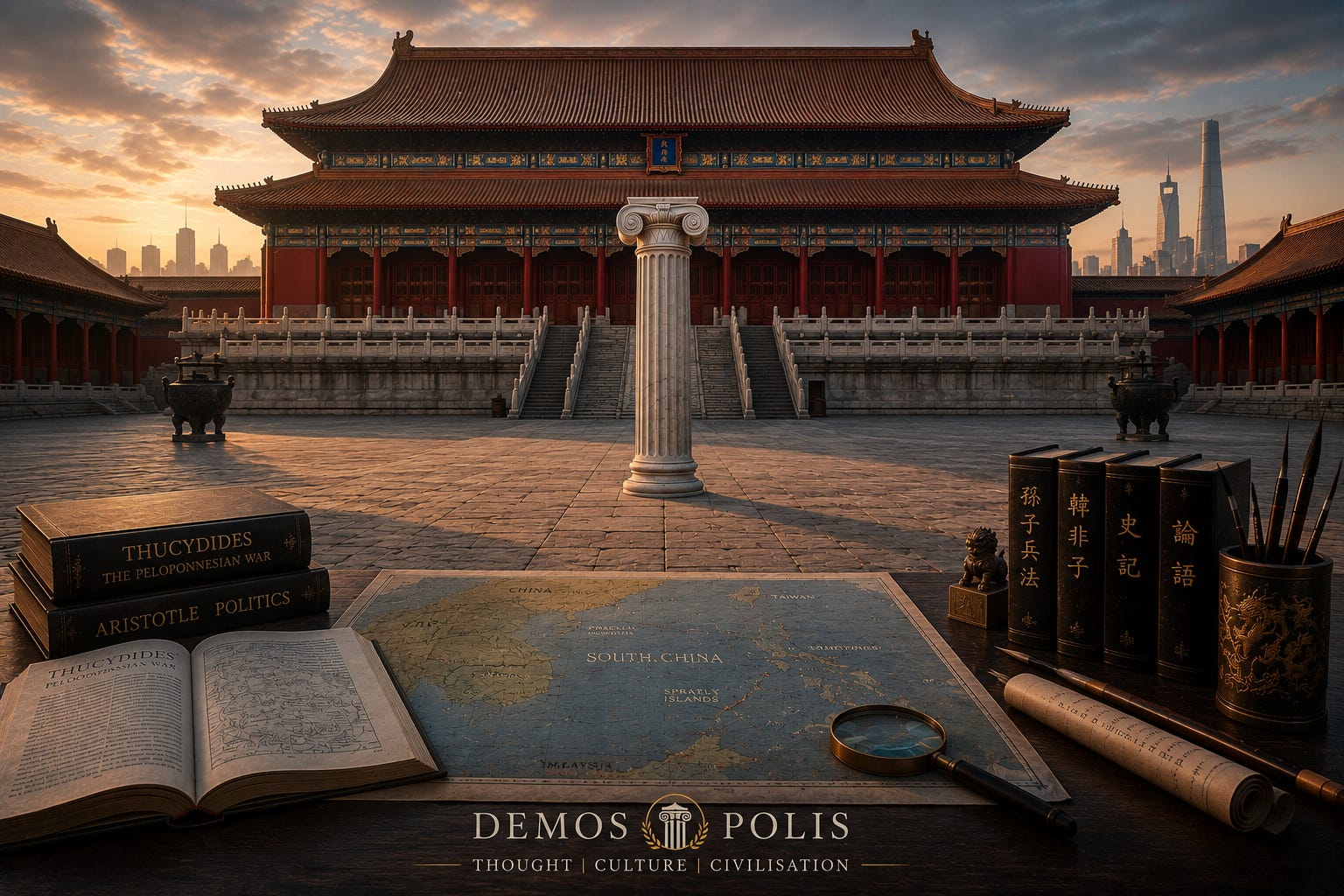
Sino-American rivalry became one of the defining questions of international politics. Policymakers and scholars on both sides repeatedly find themselves discussing a Greek historian who died twenty-four centuries ago.
Thucydides.
The question is not whether his analysis remains correct. The more interesting question is why rising and established powers alike continue to believe it is worth consulting him. Why a fifth-century BC Greek historian is invoked by American strategists, Chinese scholars, military analysts, and political leaders seeking to understand the emerging relationship between a dominant power and a rising one.
The phenomenon became known as the “Thucydides Trap,” after the historian’s observation that the rise of Athens and the fear this inspired in Sparta made conflict more likely.
Whether one accepts the concept or not is ultimately secondary.
What matters is a simpler question.
Why are twenty-first century powers turning to a Greek historian at all?
The answer reveals something important about the nature of civilisation, political judgment, and the purpose of education.
Beyond Nostalgia
The contemporary discussion surrounding Classical Studies is often framed incorrectly.
Supporters frequently defend the Classics as cultural heritage.
Critics dismiss them as relics of a vanished world.
Both positions miss a very interesting question.
States do not invest in institutions simply because they are old.
Nor do serious policymakers consult ancient authors out of sentiment.
The enduring relevance of Classical Studies lies elsewhere.
The Greek and Roman traditions constitute one of humanity’s longest-running laboratories of political experience.
Questions of power, legitimacy, civic cohesion, elite formation, war, peace, ambition, corruption, democracy, oligarchy, and imperial expansion were examined with remarkable clarity long before the emergence of the modern state.
The names change.
Human nature does not.
The Chinese Question
This is why developments in China deserve closer attention.
Over the past decade, Chinese universities have expanded Classical Studies programmes. Ancient Greek is taught. Research centres have been established. The Chinese School of Classical Studies now operates in Athens. Academic exchanges continue to deepen.
This is not mere cultural curiosity.
It is a strategic choice.
A state does not allocate resources indefinitely to activities it considers irrelevant.
China is not becoming Greek.
Nor is it attempting to become Western.
Rather, it appears to have concluded that the classical tradition contains forms of knowledge useful to understanding power, order, governance, and civilisation itself.
Whether that conclusion is correct may be open to debate.
What is beyond debate is that the investment is taking place.
The more revealing question is why.
Classical Studies and Elite Formation
Historically, Classical education was never primarily vocational.
Its purpose was not employment.
Its purpose was judgment.
For centuries, the study of history, rhetoric, philosophy, and political thought formed part of the preparation for public life.
The objective was not simply to produce knowledgeable individuals.
It was to cultivate citizens, statesmen, diplomats, administrators, and leaders capable of interpreting and navigating the complex realities of governance.
A person who had encountered Thucydides entered political life having already reflected on fear, honour, interest, alliance, faction, and the dynamics of power.
A person who had read Aristotle had already wrestled with questions of citizenship, constitutional order, friendship, moderation, and the purpose of political community.
Those texts were not decorative ammunition for aspiring dandees. They were formative. They were civilisational infrastructure.
Today, it may be more accurate to describe them as strategic infrastructure.
The Western Assumption
Much of contemporary Western education operates on a totally different assumption.
Education has long been understood through the language of employability, skills acquisition, and economic productivity.
All legitimate objectives, but not the only objectives a civilisation requires.
A society may produce highly competent specialists while simultaneously struggling to produce citizens capable of exercising judgment in moments of uncertainty.
Technical expertise and civilisational confidence are not identical.
Nor are technological innovation and political wisdom.
This distinction matters particularly at a time when technological capabilities are expanding faster than our collective understanding of how they ought to be used.
The Return of the Permanent Questions
Perhaps this explains why the classical world continues to attract attention far beyond Europe. The attraction is not linguistic or archaeological. It is anthropological.
The Greeks asked questions that remain stubbornly resistant to obsolescence.
What makes a political order legitimate?
How does a democracy decline?
What corrupts elites?
What holds a society together?
Can power be exercised without hubris?
What kind of life is worth living?
No technological innovation has rendered these questions irrelevant. If anything, their urgency has increased.
Artificial intelligence may transform economies, but it cannot determine what justice is.
Data may inform decisions, but it cannot tell us which ends deserve pursuit.
Efficiency can optimise means, but it cannot provide purposes.
The Geography of Intellectual Confidence
The significance of China’s engagement with Classical Studies therefore extends beyond academia. It points toward a broader question.
Where in the world do societies still believe that civilisational continuity crosses borders and fertilises our limited understanding? Where is conscious transmission a choice? Where do states continue to invest in the formation of judgment, not merely the production of administrative expertise?
The issue is not whether Europe should imitate China. Nor is it whether China has correctly interpreted the classical tradition. The issue is that different civilisations appear to be reaching different conclusions about the relationship between education, statecraft, and cultural inheritance. And they are not European. That fact alone deserves serious attention.
In Conclusion
The debate surrounding Classical Studies is often presented as a dispute between tradition and progress. This is a false choice. The more important distinction lies elsewhere. Between societies that regard civilisational knowledge as a strategic asset and those that regard it as an optional luxury.
When policymakers in Washington and Beijing sought frameworks for understanding the future, both found themselves consulting Thucydides.
That fact should give us pause.
The question is no longer whether the classical world remains relevant. The question is why some societies appear increasingly convinced that it is.